How to Evaluate a Tactical Dog Collar and Leash Set Before You Buy Wholesale — WildHawk's 6-Point Checklist
- Share
- publisher
- WildHawk
- Issue Time
- Nov 21,2026
Summary
A supplier-neutral 6-point checklist for wholesale buyers: denier and coating, full-circumference adjustment, MOLLE spacing, hardware quality, leash shock absorption and size-range overlap — each verifiable on a sample in minutes.
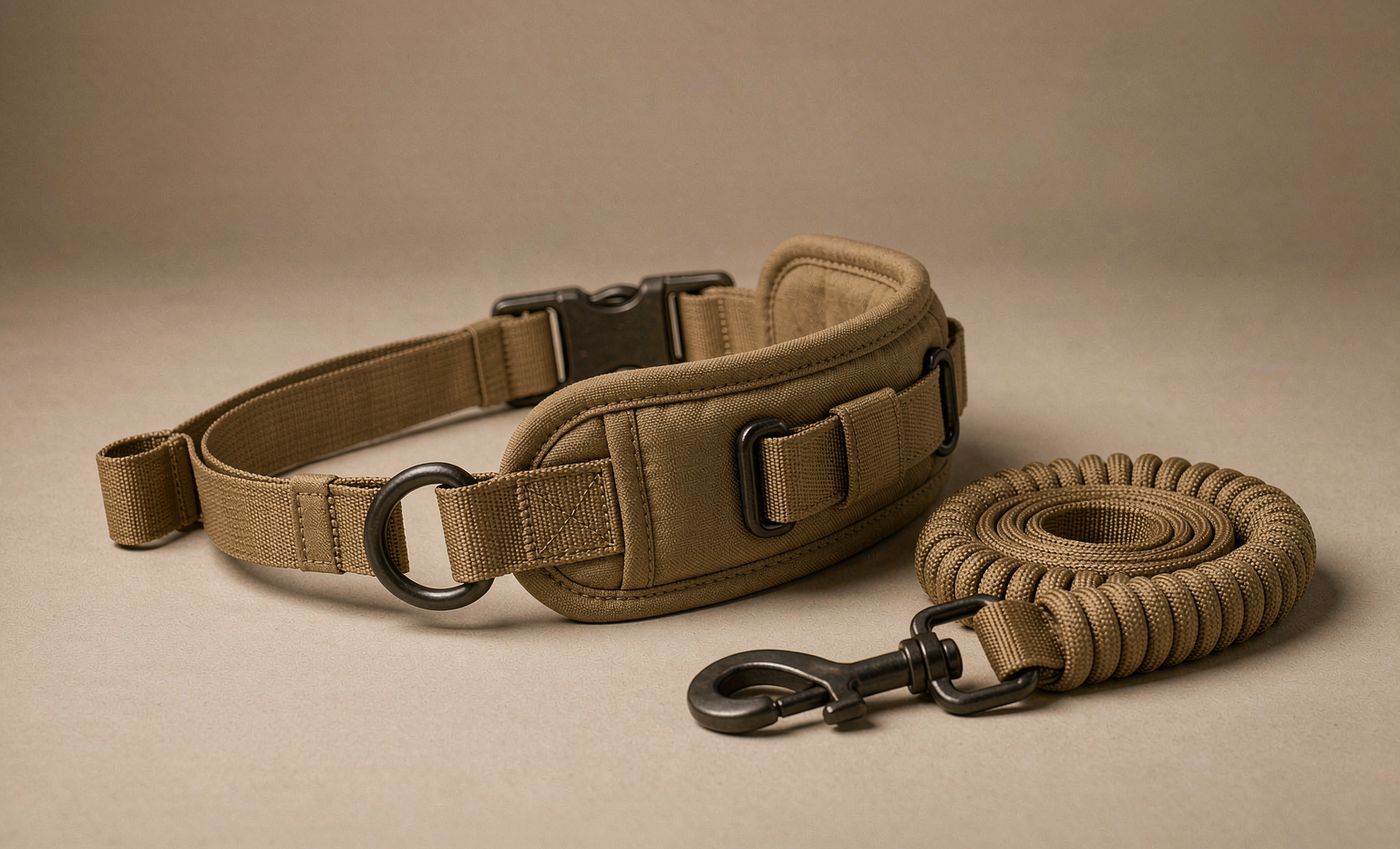
A tactical dog collar and leash set looks simple on a trade-show table: same webbing, same buckles, similar colours. What separates a set that survives a season of daily use from one that generates returns is decided by six checkable details. This checklist is written for buyers sourcing wholesale — use it before you compare quotes, and you will know exactly why two sets that look alike are not priced alike.
- Denier and Coating: What the Spec Sheet Must Say
- Adjustment Structure: Full-Circumference vs Buckle-Only
- MOLLE Compatibility: Spacing Must Match Your Vests
- Hardware Tests: Buckles and D-Rings
- Leash Shock Absorption: Test Before You Buy Wholesale
- Size Ranges That Overlap: Reading the Collar Size Chart
- Evaluate Your Next Collar Set with WildHawk
- Frequently Asked Questions
- Evaluate Your Next Collar Set with WildHawk
Denier and Coating: What the Spec Sheet Must Say
Most listings lead with denier. 800D and 1000D nylon both outperform cheap polyester webbing, but the weave density, the PU or TPU coating weight, and the UV treatment matter as much as the raw number. A loosely woven 1000D strap can fray faster than a tightly woven 800D strap with a proper coating. Ask the supplier which denier they use on the collar body versus the leash, and request the coating specification in writing.
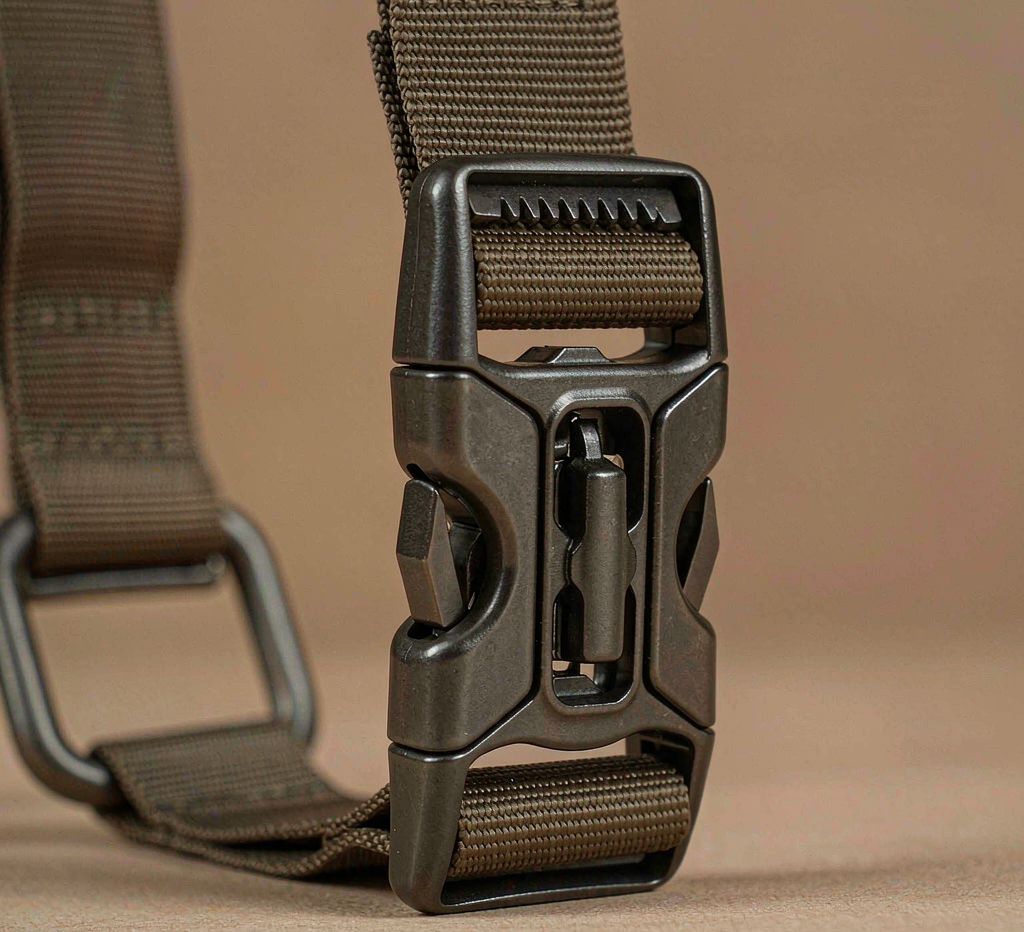
Two more stitching checks: count the bar-tacks at the D-ring junction, and look at whether the collar edge is folded or heat-cut. Folded edges protect the dog's neck and stop fraying; raw heat-cut edges are the cheapest shortcut in this category.
Adjustment Structure: Full-Circumference vs Buckle-Only
Many budget collars adjust only at the buckle. The collar then rides up on deep-chested breeds and loosens during pulling. A full-circumference design runs webbing through a tri-glide slider so tension distributes around the neck instead of concentrating at one point.
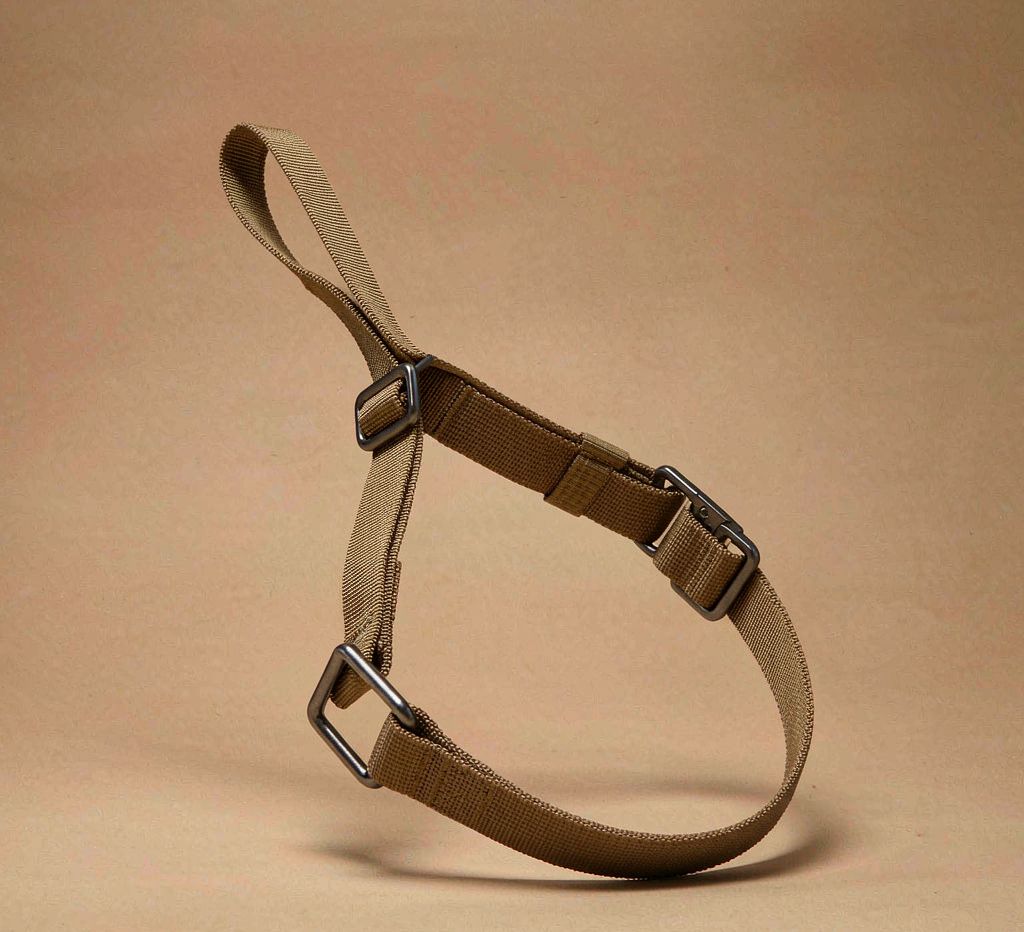
Test it on a sample: tighten the collar one stop, then pull sideways. If the webbing slips under load, your customers will return it. A tactical collar that adjusts only at the buckle will ride up on deep-chested breeds — full-circumference adjustment distributes tension around the neck instead of at one point.
MOLLE Compatibility: Spacing Must Match Your Vests
If you already sell tactical vests or harnesses, the collar set's MOLLE rows must accept the same pouches and accessories. Standard MOLLE spacing is 25 mm between rows with 38 mm webbing. Off-spec spacing is invisible in photos and fatal in assortments. Send the supplier one of your existing pouches and ask them to confirm compatibility in the sample, not on paper.
Hardware Tests: Buckles and D-Rings
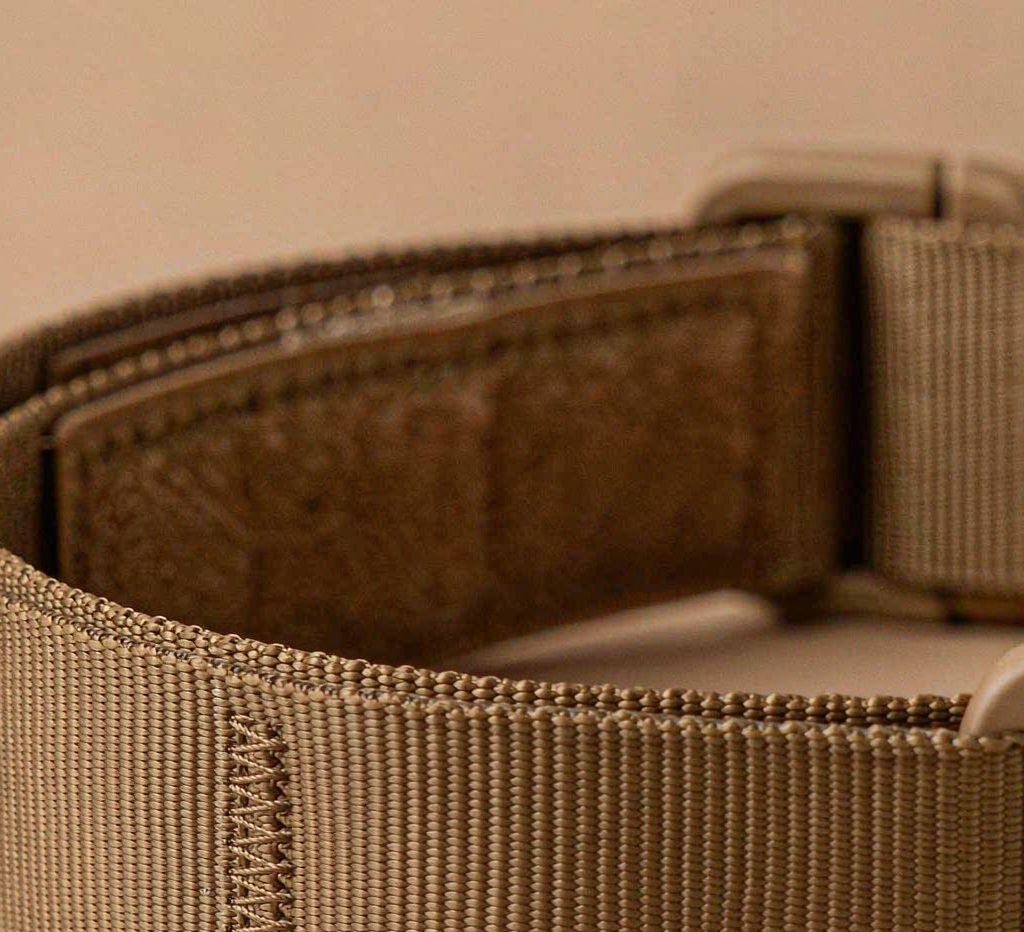
Hardware is where hidden cost-cutting lives. Check three things: the buckle release force (it should survive a hard yank without opening), whether the D-ring is welded or bent sheet metal, and whether metal parts are powder-coated or plated. Welded steel D-rings and tested side-release buckles cost more per set — and cost far less than a recall email.
Leash Shock Absorption: Test Before You Buy Wholesale
A set is only as good as its weaker half. Many "tactical leashes" are straight nylon straps. A genuine shock-absorption section — an elastic core inside the webbing near the clip — takes the spike out of sudden lunges, which protects both the dog's neck and the handler's wrist. Stretch the leash section by hand: you should feel progressive resistance, not a dead strap.
Size Ranges That Overlap: Reading the Collar Size Chart
Get the size chart, not the size names. If M, L and XL ranges do not overlap, dogs at the boundaries have nowhere to go. Ranges that overlap slightly are a feature, not a flaw — they let resellers resolve boundary cases by neck girth. The six-point summary:
| Point | What to check | Reject if |
|---|---|---|
| Denier & coating | Spec sheet: denier, coating weight, UV treatment | No written spec |
| Adjustment | Full-circumference slider vs. buckle-only | Webbing slips under load |
| MOLLE spacing | 25 mm rows, 38 mm webbing, pouch fit test | Off-spec spacing |
| Hardware | Welded D-ring, tested buckle release force | Bent-sheet D-ring |
| Leash | Elastic shock section with progressive resistance | Dead straight strap |
| Size chart | Overlapping ranges + girth guidance | Non-overlapping ranges |
Frequently Asked Questions
Is 800D nylon enough for a working dog?
Yes. With a tight weave and proper coating, 800D resists abrasion comparable to heavier loose weaves, while keeping the set light — around 120 g per set for a collar-leash pair at this spec.
How do I verify claims without a lab test?
Order a sample, run the six checks above, and photograph each one. A supplier confident in its build will send a spec sheet the same week; hesitation on a spec sheet is itself an answer.
What should a complete wholesale quote include?
Unit spec, size chart, carton packing (sets per carton, carton weight and dimensions), private-label options, and lead time for sampling and bulk. A quote missing any of these shifts risk onto you.
How do I verify MOLLE pouch compatibility before ordering?
Send the factory one of your existing pouches and ask for a fit test on the production sample, not on paper. Standard MOLLE spacing is 25 mm between rows with 38 mm webbing. A written confirmation plus a photographed fit test on the sample costs one extra day and eliminates the most expensive compatibility mistake in assortments.
Evaluate Your Next Collar Set with WildHawk
Two sets can look identical in a catalog photo and behave completely differently in a customer's hands. The difference lives in coating, adjustment structure, MOLLE spacing, hardware, leash elasticity and size-chart logic — all checkable before you commit to a container. Every WildHawk tactical dog collar and leash set is built to this checklist, and we publish the current spec sheet on request — ask for it before you compare quotes.